VEEN is curated by WSU Viticulture Extension. For questions on articles, or to request to submit an article in future issues, reach out to Michelle Moyer.
This issue of VEEN was originally published as a .PDF in April 2020, and posted online. Some content here will differ from that original issue. The issue is archived, but accessible on the VEEN Archive webpage.
A Note from the Editor
While budbreak across the region is quickly making its debut, I had a tentative note-to-self to talk about how we were starting 2020 off following average trends. But the word “average” seemed inappropriate when thinking about the timespan between last fall and now – from the vineyard to how we are now functioning in our daily lives. As we all face the future with the same level of unknowing, there is some comfort being in agriculture. While we don’t yet know the long-term impacts of COVID-19 on our production and business operations, and how it may permanently influence how we do business, we can take stock that we are in an industry that is use to “weathering the storm.” But in the past, it wasn’t really a metaphor for perseverance — we literally were responding to the randomness that was weather. Now we get to dabble a bit more in the philosophical realm.
We hope you find this issue of VEEN enjoyable. We have a great article by the WSDA on understanding quarantines, a blurb on some of the cool, plant-based approaches to sustainable disease management, some highlights on how plants self-manage water, and a great overview of how industry-driven research dollars are gathering data to help us make better grape and wine production decisions. Even better – the WSU VE Program is offering a discount on self-directed Certificate Courses, so you can keep learning through this quarantine!
Stay safe, stay healthy!
Michelle M. Moyer
Viticulture Extension Specialist
Professor of Viticulture
WSU Prosser IAREC
Table of Contents
Connect With Us
V&E Certificate Program
Ordered Out-of-State Vines? Be Compliant with WSDA Quarantines.
Author: By Aaron Paul, WSDA Plant Services
A common question from Washington growers is whether they can import grapevines from out of state. The answer is yes. If you are looking to buy grapevines from out of state, they will need to comply with the Washington State Exterior Quarantines.
Washington’s grape pest quarantine only allows grapevines from out-of-state sources that come from a state with a Washington State-approved grape certification program. This approval means that participating nurseries in these states’ certification programs have vines that are eligible for import into Washington, but there may still be additional quarantine requirements that need to be met prior to import.
The only states with grape certification programs for commercial nurseries that currently meet this requirement are Oregon and California. Grapevines may also be imported into Washington directly from the Foundation Plant Services UC Davis in California or from The Centre for Plant Health in British Columbia.
For those who might prefer a local source of certified grapevines, there are currently five nurseries that participate in Washington State’s Grape Certification Program. Grapevines may also be purchased from the WSU Clean Plant Center Northwest in Prosser.
Whether it’s a single stick of budwood, an entire truckload of rootstock, or anything in between, grapevines coming into Washington from out-of-state need to have a Phytosanitary (plant health) Certificate. This may also be called a Certificate of Quarantine Compliance.
A Phytosanitary Certificate is issued by the exporting state’s Department of Agriculture and records when the grapevines were inspected, whether they were treated for certain pests if required, and whether or not they meet the standards of Washington’s grape pest quarantine.
Prior to shipment, a copy of the phytosanitary certificate, must be sent to WSDA for pre-notification. Pre-notifications can be mailed, emailed, or faxed to the contacts listed in How to Comply with WSDA Rules below .
Once the pre-notification of a grapevine shipment has been received by WSDA, the local inspector will then review the phytosanitary certificate to make sure that the grapevines meet Washington’s quarantine. If there are any issues, the plants will be placed on hold and the inspector will follow up with the receiving and exporting nurseries.
Violating quarantines can result in shipments being rejected or destroyed at the destination, or monetary penalties against violators.
If you have any questions or concerns about importing grapevines from out of state, please contact your local inspector.
How to Comply with WSDA Rules:
- Find an approved source from Oregon or California
- Request a phytosanitary certificate or certificate of quarantine compliance, and send a copy to WSDA through mail, fax, or email.
- Nursery Inspection Program Supervisor
Plant Protection Division WSDA
1111 Washington St. S.E.
P.O. Box 42560 Olympia, WA 98504-2560
Fax: 360-902-2094
E-mail: nursery@agr.wa.gov
- Nursery Inspection Program Supervisor
- Such notice shall include, but not be limited to, the following information:
- The approximate number of grapevines, rootstock, or softwood cuttings
- The shipper
- The consignee
- The method of treatment used, if applicableThe approximate date of delivery
- If there is an issue or a question regarding your order, your local inspector will follow up with you.

Powdery Mildew Management Toolkit: Disease Resistant Varieties
Author: Michelle Moyer, WSU Prosser IAREC
Application of fungicides is by far the most common tool in our powdery mildew management toolkit. But using that tool effectively is increasingly challenging.
With increasing acreage and fewer trained tractor operators, the ability to effectively complete a spray pass in a reasonable amount of time is limited. Fungicide resistance, and the resulting emphasis on product rotation and timing limitations, has severely limited many grower’s chemical choices.
Cultural control strategies are often under-utilized. Canopy management can be labor intensive when done by hand, and its timing is often misaligned with optimal disease management due to labor scheduling. Mechanization of canopy management practices, which can solve the labor, and thus, timing issue, is still not as widely practiced as it should be.
One cultural tool, though, that the wine world neglects more than any other, is the use of disease resistant varieties. Modern disease-resistant grape varieties strongly mimic Vitis vinifera, and represent a significant improvement over older resistant varieties. They are developed through conventional breeding programs, using modern tools (DNA markers) to help screen for disease resistance and fruit quality early in the breeding process.
Used as a tool to reduce disease pressure or whole-farm fungicide inputs, these varieties have potential for practical integration into modern production systems, whether they are organic or conventional. They are the varieties that could propel the industry to a more sustainable future.
Is the concept of a disease resistant wine grape variety new to you? Check out the articles in the left information box. You can also learn more about grapevine breeding efforts in the United States at the VitisGen website.
Varieties in the Pipeline
Interested in reading up on the new selections making their way through the breeding pipeline? The VitisGen project has a webpage on the varieties, complete with fruit descriptions and images.
VitisGen2 Articles
- The Frozen Genetics of International Wine Cultivars. Wines and Vines, December 2017.
- Grape Breeders No Longer Flying Blind. Wine and Vines, March 2018.
- Will Europe Embrace Hybrid Wine Grapes? Wines and Vines, August 2018.
- The Phenotyping Bottleneck: How Grape Breeders Link Desired Traits to DNA Markers. Wines and Vines, December 2018.
- Disease-Resistant Varieties Are On The Way: Can We Ensure They Last? Wine Business Monthly, June 2019.
- Grape Breeders Search for Reliable DNA Marker: Why the Pinot noir PN40024 Reference Genome is Not Enough. Wine Business Monthly, December 2019.
Grapevines Adapt to a Reduction in Irrigated Soil Volume
Author: Nataliya Shcherbatyuk and Markus Keller, WSU Prosser
What We Think We Know
We know the mechanism of water transport through the soil to the atmosphere through a plant’s root system. We don’t know how grapevines cope with a reduction in the irrigated soil volume. An example of a reduction in irrigated root volume occurs when a vineyard is converted from flood or furrow irrigation to drip irrigation. During drip irrigation, the wetted soil volume is less than 35% of the total soil volume available for exploration by the roots. Another example where only a portion of the root system is irrigated is during partial rootzone drying (PRD), an irrigation method that exploits the physiological response of grapevines to spatial water limitation. This method conserves water and controls canopy growth, and we think that the vines keep their drying roots alive by moving water to them from their wet roots.
Thus, alternative irrigation techniques often restrict water availability to a localized soil zone, both spatially and temporally. The use of alternative (deficit) irrigation approaches is the motivation for understanding water transport mechanisms and root longevity in the long term. This is important because many growers worry that reducing the irrigated root volume by implementing changes to the irrigation method in an established vineyard will render vines unable to take up enough water to support their canopy and crop.
Our Approach
To study how grapevines cope with a reduction to the irrigated soil volume, we conducted an experiment during the summer of 2019 at the WSU Irrigated Agriculture Research and Extension Center in Prosser, WA. We grew own-rooted Merlot vines in 7-gal PVC pots that had one, two, or three root compartments as shown in Figure 1. The vines that grew in split pots had previously been split along the lower trunk to create two or three sub-trunks, each with its own root system.
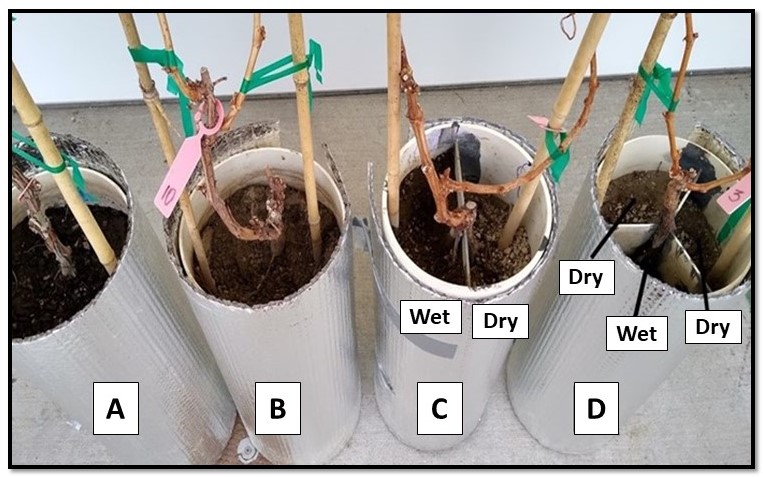
Initially, we irrigated all compartments of all vines based on the evapotranspiration demand to avoid water stress. Then the same required water amount was supplied daily to only one pot compartment, while the soil in the remaining pot compartments or pots was allowed to dry down (Figure 1). In other words, while all irrigated pots received the same amount of water, we irrigated either 100% (fully irrigated control), 50%, 33%, or 0% (non-irrigated control) of the vines’ root system. The dry-down period lasted 54 days (August through October), and during this time we measured midday leaf water potential and leaf gas exchange (transpiration, photosynthesis, and stomatal conductance) twice a week.
In another experiment, own-rooted Merlot vines that were similarly split along the lower trunk were grown in transparent plexiglass containers with three 12-gal root compartments that were covered with removable insulation. This allowed us to monitor root growth in each compartment. We irrigated only one of the three compartments (33% of the vines’ root system), while the two other compartments were left to dry down for 2 months. We girdled the sub-trunk above one of the two drying compartments to test if a bark (phloem) connection between the root system and the canopy was necessary to keep the drying roots alive.
Take-Away Message
Stomatal closure is one of the first responses of grapevines when the soil dries down and the leaf water potential decreases due to water stress. When we completely withheld water (i.e., 0% of the pot volume irrigated) in our Merlot grapevines, both midday leaf water potential and stomatal conductance declined rapidly. Our measurements indicated severe water stress about 3 weeks into the dry-down period, dropping below -1.5 MPa and 0.05 mol per m2s, respectively (Figure 2).
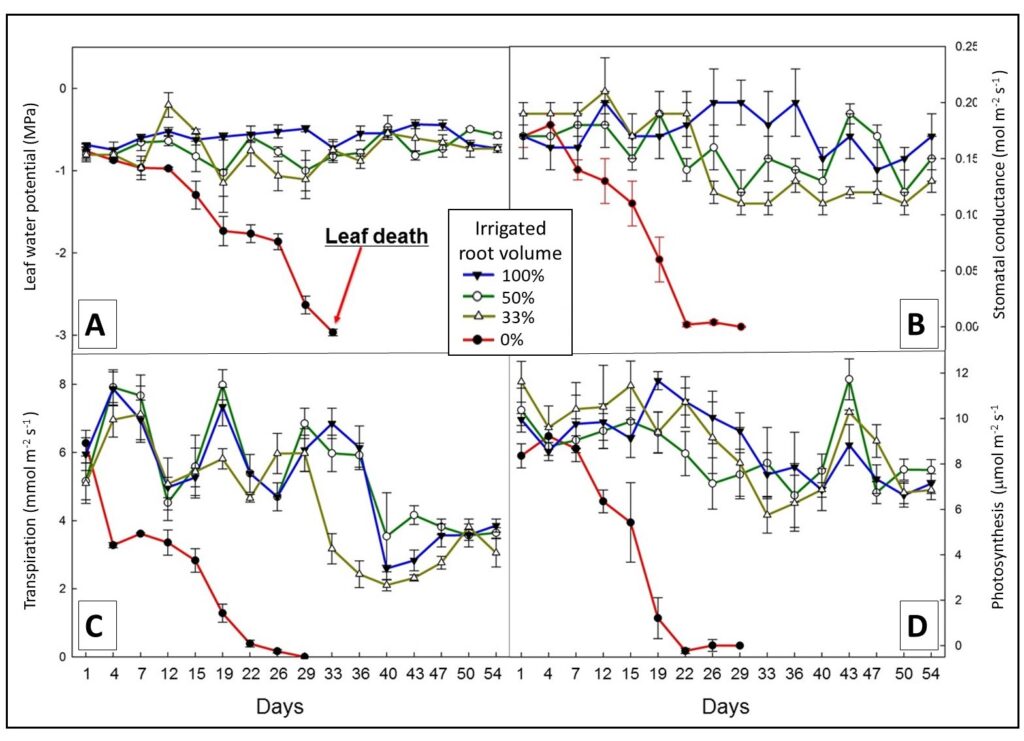
By contrast, irrigated vines did not drop their leaf water potential below -1 MPa over the 2-month period irrespective of whether all or only a portion (50% or 33%) of the soil system was irrigated. This indicates that those vines did not experience water stress. However, as the irrigated soil volume decreased, so did stomatal conductance, but the stomata remained partially open so long as a portion of the root system was irrigated. The change in stomatal conductance was reflected in a reduction in the transpiration rate but not in photosynthesis (Fig. 2). We conclude that as the irrigated soil volume decreased, the vines increased their water use efficiency. With only a portion (50% or 33%) of the entire root system being irrigated, higher water use efficiency allowed these vines to maintain photosynthesis, and hence sugar production in the leaves, while conserving water by decreasing transpiration.
How exactly grapevines cope with a reduction of the irrigated soil volume is still not clear. It remains unknown how such vines manage to provide the required amounts of water to the transpiring canopy. It is possible that when local water is available somewhere in the soil, the roots adjust water supply via compensatory growth and/or increased hydraulic conductance. Our plexiglass “root observatory” showed that while irrigated roots continued to grow, the non-irrigated roots on the same vine stopped growing – but they were still alive. When the phloem was girdled, the non-irrigated roots died. This was confirmed at the end of the 2-month dry-down period, when the roots were excavated (Figure 3).
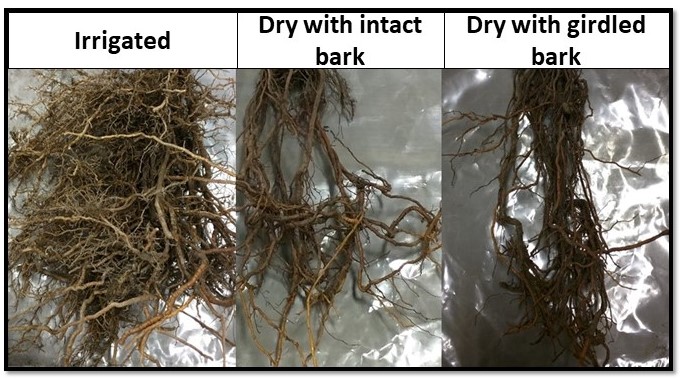
We conclude that water from wet roots can hydrate drying roots through the intact phloem of the vine to keep them alive. How do grapevines do this? Other experiments in our lab, using “heavy” (i.e., deuterium-labeled) water, demonstrated that the roots in a wet soil region take up water and transport it to the leaves via the xylem. Most of this water evaporates from the leaves during transpiration, but some moves to the phloem along with sugar produced during photosynthesis (some of the water is even used to build the sugar in the first place!) and is “recycled” down to the roots in both wet and dry soil regions.
Deficit irrigation in all its forms is used to increase fruit quality and decrease water use. Our work demonstrates that grapevines, with decreased irrigated soil volume, do not experience more water stress than fully irrigated vines as long as water is available to a portion of the root system. We showed that even a small portion (1/3) of the root system can fulfill vine water needs by increasing water use efficiency. Although most of Washington’s wine industry has already converted to drip irrigation, much of the juice grape acreage is still irrigated by flood, furrow, or overhead sprinkler irrigation, often out of fear that drip irrigation cannot supply enough water to the large juice grape canopies. Our work has shown that grapevines are resilient and can cope effectively with a significant reduction in irrigated soil volume.
New Funds Strengthen WA Wine’s World-class Research Program
Author: Melissa Hansen, Research Program Director, Washington State Wine Commission
Viticulture and enology research is strong in Washington – and it’s about to get stronger. The Washington State Wine Commission is offering new grant programs, and paired with federal research dollars, promise new scientific breakthroughs for growers and winemakers.
Though the world has been on hold since March, there’s no pause for pest, cultural, climate and winemaking challenges that grape growers and wineries face. From fungicide resistance in powdery mildew to phylloxera, grape mealybug and a new species of grape leaffolder, pest management issues change but never go away. Unpredictable wildfires and frosts also create challenges each year. This is where research comes in.
Increased Federal Funds
Thanks to the successful lobbying efforts of Washington and Oregon grape and berry industry stakeholders, Congress appropriated $1.5M for research this year for small fruit research that’s headed to the Northwest Center for Small Fruits Research and $1M for a USDA precision viticulture scientist that could be located at WSU Prosser IAREC. In addition, another USDA scientist will soon be hired to work in grapes.
The Small Fruits group is a research consortium, bringing together Washington, Oregon and Idaho grape and berry organizations, their land-grant university research programs and USDA’s Agricultural Research Service. The consortium is based at USDA’s Horticultural Crops Research Unit in Corvallis, Oregon. Dr. Inga Zasada, who has worked in Washington wine grape vineyards with WSU’s Dr. Michelle Moyer on nematodes, was appointed Research Leader of the ARS unit in January. She leads a team of about 30 scientists and technicians who focus on horticulture, plant pathology, entomology, chemistry, and physiology for small fruit (berries and grapes) and nursery crops. These ARS scientists have worked in tandem with our university researchers on projects like grape powdery mildew, soil health and nutrition and nematodes.
The new $1.5M designated for small fruits research will help sustain funding of a long-standing, competitive grant program of the Small Fruits Center. Several WSU V&E scientists have received these grants in the past. The grant program helps leverage research dollars from the Washington grape and wine research program.
Congress also appropriated $2M in 2020 to USDA for grape smoke exposure research, a direct result of lobbying efforts of the Washington Winegrowers Association and its sister organizations in California and Oregon. WSU’s Dr. Tom Collins, recognized as a leader on the topic, is working closely with others at Oregon State University and the University of California in developing a collaborative research plan with USDA. The three universities are also preparing a planning grant to develop a multi-million dollar proposal for the USDA – Specialty Crop Research Initiative.
Expanded Reach
Another key move was the Wine Commission’s recent launch of two new research grant programs. These programs, both funded solely by the Washington wine industry, will expand the industry’s reach.
The first program awards grants for short-term, demonstration projects conducted by state community colleges and universities. Past research surveys administered by the Wine Commission highlighted the need for wine and vineyard extension-type trials that don’t fit traditional research parameters. Moreover, exposing community college students to research may inspire them to pursue V&E or research studies. The second grant program is designed to encourage research collaboration between Washington and other wine regions by providing a means to fund projects beyond state borders.
Wise investment
Though it seems like the stars aligned for V&E research this year, this increased funding is a product of the great success of WSU’s previous grape and wine research projects. So far we’ve seen water savings, reduced pesticide use, reduced wine spoilage and an overall improvement in wine quality. We’ll keep sharing outcomes of these research projects with industry, government officials and the public to shore up support for V&E research to tackle issues like smoke exposure, grape pests, vine water use, and more. Research is a wise investment for the future health of the Washington wine industry.