VEEN is curated by WSU Viticulture Extension. For questions on articles, or to request to submit an article in future issues, reach out to Michelle Moyer.
This issue of VEEN was originally published as a .PDF in September 2020, and posted online. Some content here will differ from that original issue. The issue is archived, but accessible on the VEEN Archive webpage.
A Note from the Editor
It’s still 2020? It’s still 2020. What a year it has been. For many of us, our personal and professional lives look nothing like they did a year ago. We’ve experienced working and living in and through a pandemic. We’ve watched education and communication change, and have watched as the west coast was, or what felt like, being consumed with smoke and wildfires. We’ve made vineyard and winery changes and policies we never thought we would have to make. We’ve explored a whole new world of digital marketing, and have reached consumers and advocates we never reached before. We have postponed traditions, and have learned new ways to connect. While it is hard to focus on the positive when so much is changing, the fact that there is some positive in 2020 highlights our, and our industry’s, resilience. (But it’s also nice to know that 2021 is only a few short months away!).
With this Fall 2020 edition of VEEN, we present some opportunities for online pesticide credits, and educational resources on smoke exposure; we have some interesting information on a new (but maybe non-pest?) insect in Washington vineyards, as well as sneak peak at an updated AgWeatherNet. We also have a few teasers for upcoming winter meetings.
Stay safe and healthy — until we ZOOM again!
Michelle M. Moyer
Viticulture Extension Specialist
Professor of Viticulture
WSU Prosser IAREC
Table of Contents
Connect With Us
V&E Certificate Program
Pesticide Recertification Credits and Licensing
By Carol Black, WSU Pesticide Education Specialist
Due to COVID-19, there are several changes to obtaining recertification credits and taking pesticide license exams. Washington State Dept. of Agriculture (WSDA) is the regulatory agency that administers the pesticide program.
Recertification Credits
There are no extensions for the 2020 recertification cycle. If your five-year cycle ends in 2020, the last day to obtain credits is Dec. 31, 2020.
Currently, there are no in-person courses scheduled because of social distancing and disinfection requirements. However, there are ample webinars and self-paced Internet courses. WSDA posts all approved courses to their website.
WSU’s Pesticide Education Program is offering five 3-hour webinars in 2020 and again in 2021. The topics are weed management, pest management, environmental issues, pesticide laws/compliance, and invasive species.
WSU has many 1-hour, self-paced Internet courses for credit. Links to these resources are below:
- WSDA Pesticide Licensing
- WSU Pesticide Education Program – click on “recertification” and then either “webinars” or “internet courses”.
To find out what your recertification cycle is and your number of current credits, visit WSDA’s License Search website.
Private Applicators need 20 credits within five years, with no more than 10 credits allowed per year.
Obtaining a License
WSDA offers testing on its regular schedule, except Everett. However, fewer people can test at a time due to social distancing requirements. Please contact your nearest WSDA testing facility prior to arriving for a test to ensure they can accommodate you.
A few WSU County Extension offices currently accommodate private applicators, but many counties still do not allow public visitors. Please call your local office to confirm testing capabilities and rules.
The WSU Pesticide Education Program offers monthly webinars to review for the Private Applicator exam (6-hour webinar) and live webinars for the Laws & Safety, Weed Management, and Insect & Plant Disease Management Exams (3 hours each). The Program also offers self-paced Internet exam-review courses that can be completed and repeatedly reviewed. The WSU Publications office is staffed for making sales of pesticide study materials.
Additional information on Licensing Education, where to purchase course materials, and where to test are found at the websites linked below:
- WSU Pesticide Education Program: click Pre-license and either Webinars or Internet Courses
- WSU Pesticide Study Materials
- WSDA Testing Information and Locations
Leafminers: A New Insect in Washington Vineyards
By David James, WSU Prosser IAREC
Some insects suck the sap out of grape leaves. Some simply chew them. Others will fold leaves and skeletonize them. Now we have a new insect that mines a tunnel between the upper and lower surface of the grape leaf, consuming plant material from the inside as it were.
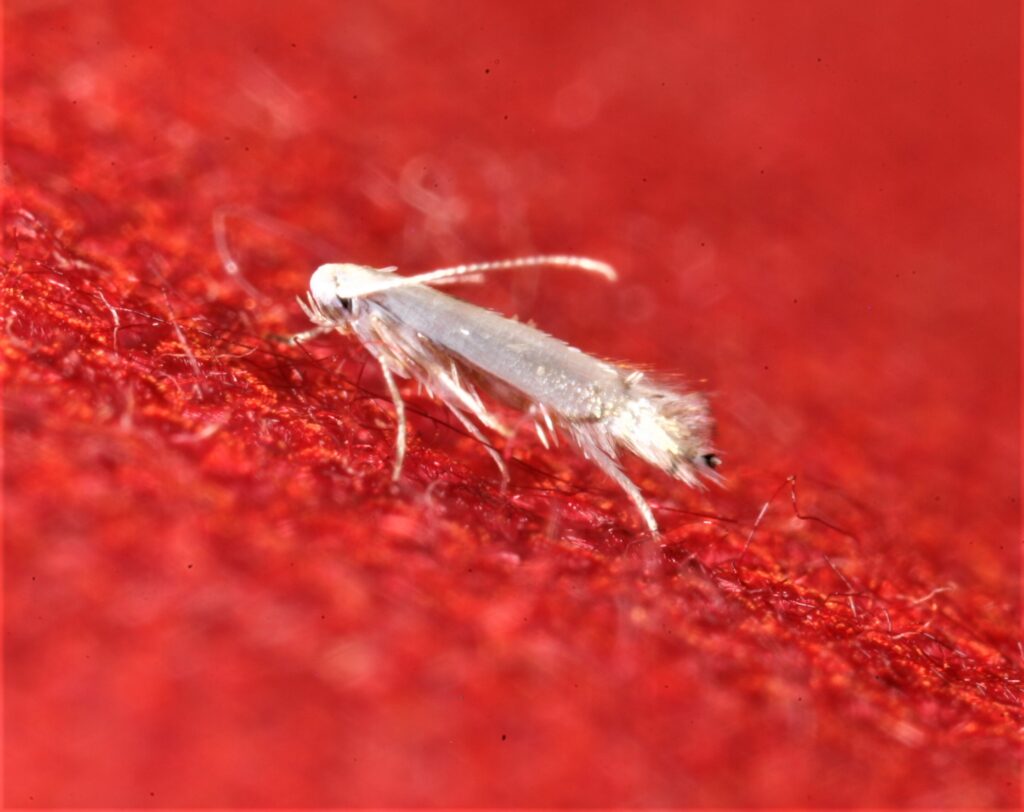
Leafminers are common on many plants but they are rarely found on grapes. However, in September we became aware of grapevines in two or three locations in the Tri-Cities area of eastern Washington, that had tell-tale signs of leafminer presence. Mining inside a leaf leaves a very characteristic sign, a kind of serpentine ‘scribble’ on the upper leaf surface (Figures 1 and 2). The miner is the larva or caterpillar of a tiny moth. It lives its entire life eating and growing inside the mine wandering about in the leaf, leaving a characteristic trail. When full-fed it pupates inside the leaf at the end of the trail before emerging as a 3 mm long moth! (Figure 3).
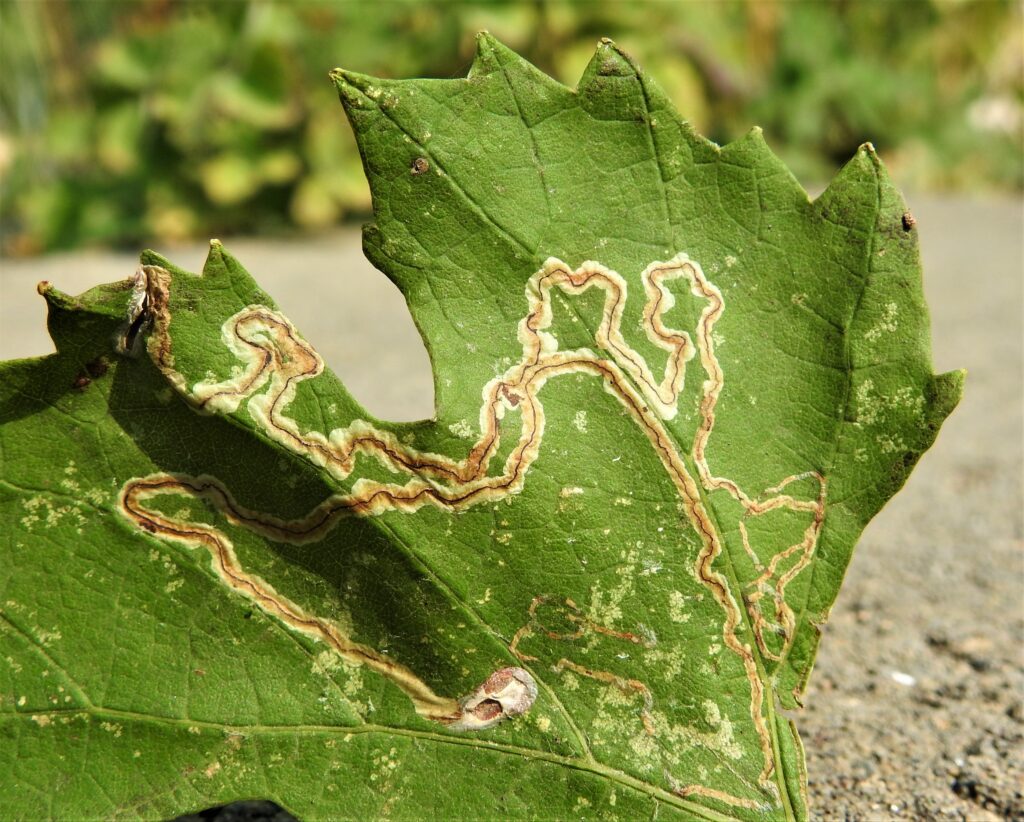
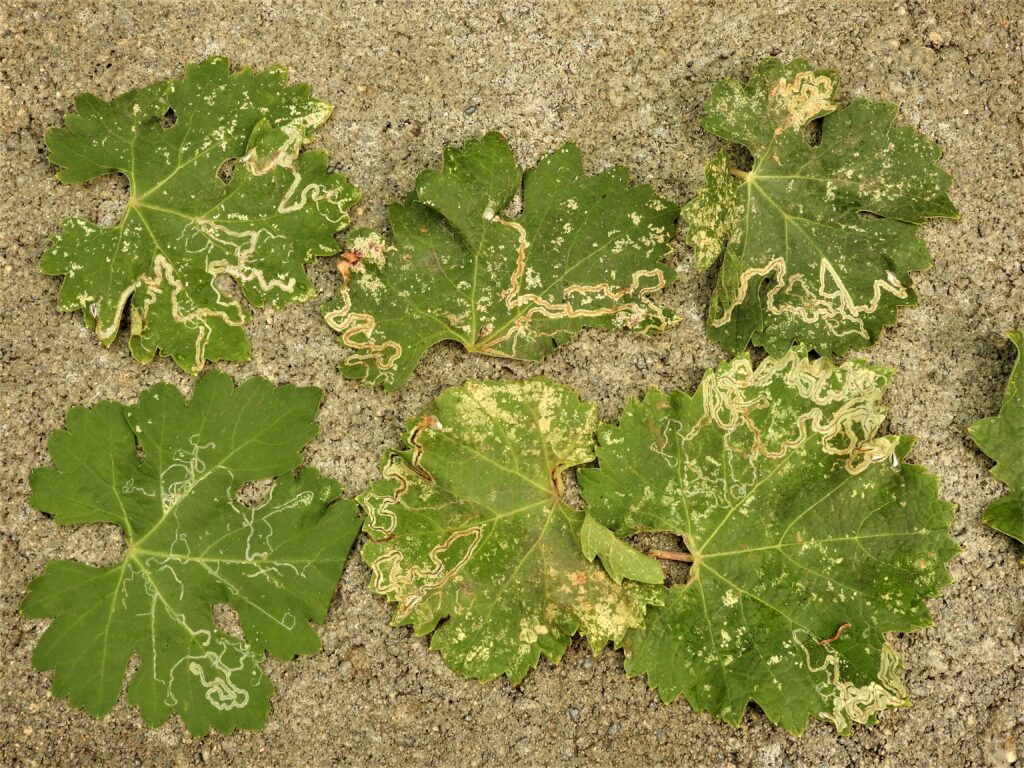
Our early investigations indicated that our grape leafminer species is in the genus Phyllocnistis and initially I thought it was either P. vitifoliella or P. vitigenella. As you can tell by these names, both species have a preference for grape, although neither have been recorded in Washington. Phyllocnistis vitigenella, known as the American Grape Leafminer has recently established in some European viticultural areas and is causing some concern.
I contacted the North American expert on leafminers, Charley Eiseman, and he believes our species is a new and undescribed species. Different species of leafminers produce unique trails and the leaf mines can therefore be used to identify species in many cases. The mines on our grapes are different from the mines produced by the two species mentioned above. I have sent him some of our leafminers and he will arrange for DNA barcoding to see whether he is correct in thinking that our species in Washington vineyards is a new species.
While this leafminer may not become a serious issue for Washington grape growers, we need to keep an eye on it and to understand its role in the ecology of IPM in Washington vineyards. We also need to identify it and understand its biology and ecology. Being an unknown species means we have no information on its damage potential.
Consequently, I would like to ask that everyone keep their eyes open for this pest. If you see symptomatic leaves, please notify David James at WSU: david_james@wsu.edu. Over the next year, we will evaluate the occurrence of leafminers in Washington vineyards to determine their distribution, abundance and damage potential.
In the first samples of leafminer-damaged leaves we examined, we found small wasps from the family Eulophidae parasitizing leafminer larvae and pupae, so some degree of natural biological control is already occurring, which is great news!
AWNfarm: A New Site – and Crop – Specific AgWeatherNet App
By David Brown (Director), Sean Hill (programmer), Joe Zagrodnik (post-doctoral researcher), WSU AgWeatherNet
Big AgWeatherNet changes are underway with a focus on delivering better weather data, forecasts and decision-support tools for agricultural stakeholders. The AWN team now includes five staff members with expertise in meteorology and atmospheric science. With this expertise we are pursuing a number initiatives that will benefit the wine industry. We are also systematically improving station siting, installing towers for inversion monitoring, adding new stations to our network, and ingesting data from approved private weather stations. Using state-of-the-art physical weather models and data science techniques, we are in the process of automating quality assurance and data imputation processes, deploying station-specific forecasts, and developing interpolation models to estimate site-specific weather conditions.
AWNfarm App
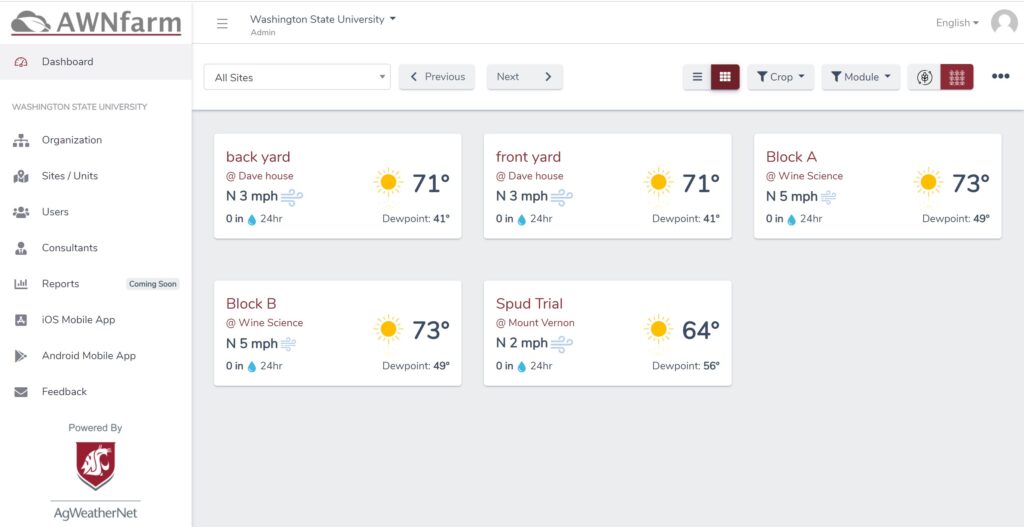
Over the past year, the AWN team has been developing an integrated web- and mobile-app platform. While many features are still in development, the basic platform is available (at no cost) to the public at the AWNFarm website as well as iOS and Android app stores. This cloud-based platform should be a fast and intuitive way to access AWN tools (Figure 1).
Block-Level Decision Support
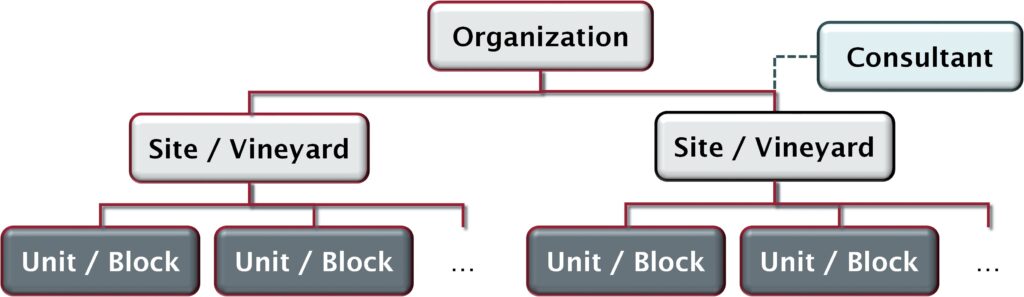
Different varieties, trellis systems, or microclimates within a vineyard? No problem. The AWNfarm platform features block-level decision support (Figure 2). Viticulturists provide one-time block-level information on variety, trellis system and temperature offset. Current and future AWNfarm modules use this information to automatically tailor guidance at the block level. Additional features include organizational administrator control over user and consultant access, as well as the ability for all users to filter by site/vineyard.
Crop, Season, and User-Specific Decision-Support
A weather-related decision support platform designed to meet the needs of diverse Washington agricultural stakeholders can quickly become cluttered with an overabundance of tools. Some organizations only grow grapes while other organizations produce diverse crops including wine grapes. And different users have different needs.
To simplify user experience, for wine grape management units the AWNfarm platform only displays grape-related decision support tools. By default, tools are displayed on a seasonal basis (e.g., no grape cold hardiness in July.) Users can add or remove tools from view (including cold hardiness in July!) To add additional flexibility, a “snap view” under development gives users the ability to customize a summary module with key weather data, decision-support metrics, and alerts for each block.
A list of AWNfarm modules (current, under development and planned) relevant to the wine industry is provided in Table 1. AWN farm researchers are also actively seeking funding for the development of weather forecasting and nowcasting models to inform frost mitigation and pesticide spray guidance modules.
| Module Description | Expected availability |
|---|---|
| Current weather conditions | current |
| Meteogram (visualize recent & forecast weather) | current |
| Occupational heat stress | current |
| Snap summary view (user customizable) | 11/2020 |
| Grape cold hardiness | 11/2020 |
| Powdery Mildew (revised w/ Michelle Moyer) | 3/2021 |
| Nematode (w/ Michelle Moyer) | 3/2021 |
| Irrigation | TBD |
Hyperlocal Weather
The AWNfarm platform is designed to use hyperlocal weather information to guide block – level decision-making (Figure 3).
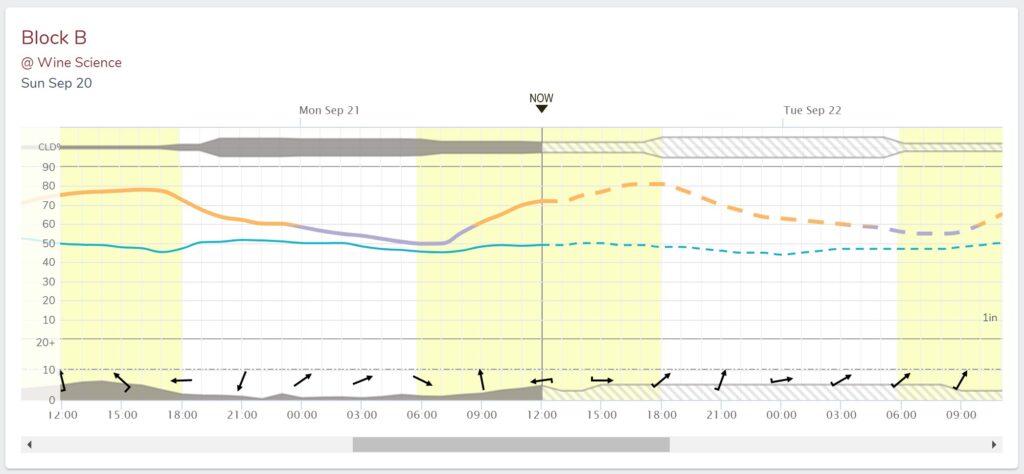
Site – specific interpolation and forecast models are currently in development. Currently, users can generate block-level weather data via two approaches:
- The AWNfarm platform allows users estimate block-specific weather conditions through a weighted average of 1 to 3 nearby AgWeatherNet and / or Agrimet stations. Users can also input a fixed air temperature offset for individual blocks.
- AgWeatherNet also uses data from approved private weather stations. If your vineyard is not represented by current AgWeatherNet stations, you can install your own station and feed site-specific weather data into AWN. Details on approved stations and siting guidelines will be released in Oct. 2020.
WA Researchers Lead Way on Smoke Exposure in Vineyards
By Melissa Hansen, Research Program Director, Washington State Wine Commission
Smoke exposure in vineyards is an urgent issue, and Washington State University (WSU) researchers are leading the charge to address it. Four years ago, the Washington State Wine Commission’s (WSWC) board of directors approved the Wine Research Advisory Committee’s recommendation to support a WSU-led smoke exposure research project, though at the time many saw smoke events as rare, isolated and regional, and not a high priority. In Australia, researchers began studying smoke exposure on grapes in the early 2000s, but in 2016, WSU was among the first in the United States to commit funding to better understand its impact.
To date, the Washington wine industry has directed over $365,000 toward WSU’s smoke exposure research program led by Dr. Tom Collins. He has shared research findings at several WAVE (Washington Advancements in Viticulture and Enology) seminars and webinars and industry meetings, including a webinar on September 16 titled Smoke Status in Washington. His most recent report is archived on the Wine Commission’s website.
Smoke exposure research has proved quite complicated. The first step of Dr. Collins’ work was to develop portable hoop houses that could simulate smoke events and be replicated. He has begun to address some of the many issues involved with smoke exposure, from looking at differences in fuel source (important to eastern Washington vineyards because we have experienced smoke events from both mountain forest fires and grassland and sagebrush fires) to mitigation of wines impacted by smoke. But more work is needed.
Fortunately, smoke exposure research has become a high priority for wine industries of the west coast and research has ramped up at Oregon State University, University of California, and University of British Columbia.
West Coast Task Force
In early 2020, the West Coast Task Force was created to combine efforts on smoke exposure research. The Washington, Oregon and California wine industries are collectively addressing three areas: contracts, crop insurance, and research. Washington Winegrowers, WSU, WSWC, and Ste. Michelle Wine Estates are representing Washington on the task force.
The task force developed protocols that deal with grape sampling for growers and micro-fermentation for wineries and a video showing how to conduct micro-fermentations. More task force tools are coming, including guidance on the claims process of crop insurance, a risk management tool for smoke damage, and a roadmap to guide growers and vintners on how and when to address issues from smoke events. The task force plans to host a conference next spring in Sacramento, CA to bring growers and vintners together to discuss shared problems and solutions.
Leveraged Research
Dr. Collins’ initial smoke simulation trials with hoop houses at WSU’s Prosser research vineyard helped leverage additional research funds. In 2019, he received an award of more than $243,000 from the Washington State Department of Agriculture’s Specialty Crop Block Grant Program. Also, in 2019, a collaborative research team of WSU, OSU and UC was awarded a $50,000 planning grant from the U.S. Department of Agriculture’s Specialty Crop Research Initiative.
Planning Grant
The planning grant for risk assessment of smoke exposure on grape and wine quality brings together the powerhouse research team of Drs. Elizabeth Tomasino of OSU, Anita Oberholster of UC, Davis and Collins at WSU. The team held a series of industry stakeholder meetings of west coast states last winter to determine gaps in current knowledge and identify industry research priorities.
Industry stakeholders provided a broad list of needs to the research team to help growers and wineries more effectively manage smoke exposure. This list includes: identifying specific smoke exposure marker compounds and their sensory threshold levels in various varieties, removing unwanted compounds without impacting wine quality, developing rapid, reliable tests that could be done in the vineyard or winery, and more.
The planning grant team is developing a robust research proposal to submit to USDA that will include the following high-level objectives:
- Develop methodologies for grape sampling in the vineyard, small-scale winemaking and analysis of targeted smoke compounds.
- Determine variety – specific sensory thresholds in wine.
- Develop environmental sensors for remote smoke exposure risk detection in the vineyard.
- Conduct economic modeling of risk in the vineyard.
Additional Work Needed
The long list of research needs identified by stakeholders is more than can be addressed in a single USDA specialty crop grant. Researchers are working to secure funding to address additional priorities outside the scope of the grant proposal. In 2020, USDA allocated $2 million for smoke exposure research, with some of the funds supporting work at WSU, OSU and UC. Efforts to continue the role of USDA in smoke exposure research are underway.