VEEN is curated by WSU Viticulture Extension. For questions on articles, or to request to submit an article in future issues, reach out to Michelle Moyer.
This issue of VEEN was originally published as a .PDF in September 2013, and posted online. Some content here will differ from that original issue. The issue is archived, but accessible on the VEEN Archive webpage.
A Note from the Editor
If we have learned anything from this vintage, it is that timing is everything. Whether it is the timing of heat accumulation, the timing of precipitation, the timing of spray applications, or the timing of harvest, we are at the whims of Mother Nature’s personal task-list. Luckily, through experience and research, we have learned which times in the growing season are ultra-critical, which management practices can be utilized to help minimize negative effects, and which events are unavoidable.
In this issue of VEEN, we have a few updates on just that: the timing of different practices. After learning about mite research in Washington, read up on how the timing of water influences vine bud break, followed up with an update on the new and improved Irrigation Scheduler Mobile, designed to help you determine the timing of irrigation. We also have a brief update from the Wine Microbiology lab in Pullman, with a discussion on managing Brettanomyces in wine; and of course, timing of additives and temperature play an important roll!
Full of different resources, we hope you enjoy this Fall issue of VEEN!
Michelle M. Moyer
Viticulture Extension Specialist
Assistant Professor of Viticulture
WSU Prosser IAREC
Table of Contents
Connect With Us
V&E Certificate Program
Mites and Microscopes: Inmates Helping with IPM
By David James, WSU Prosser
At the turn of the 21st century, when most people were concerned about ‘Y2K bugs’, Washington grape growers were spending a great deal of time and money combating a different pest: spider mites.
At that time, pest management for other insects besides mites often included the use broad-spectrum (BS) insecticides. While effective at killing the target insect, these products also had adverse effects on insect predators in the vineyard. The loss of vineyard insect predators, which preyed on spider mites keeping population explosions under control, resulted in regular spider mite outbreaks.
When the BS insecticides were replaced by more selective materials in the early 2000s, insect predators reestablished, and spider mite outbreaks curtailed. But natural systems are a constantly changing environment. In this new insecticide-minimized setting, a different mite population developed: rust mites. After causing panic for a season or two, natural predators and sulfur restored calm. Since then, it has been fairly quiet on the mite front except for some ‘odd’ occurrences of ‘strange’ mites we didn’t know lived on Washington grapevines. It was about that same time that Washington State University did a detailed survey on grapevine mites (2001-2002).
Of course, a lot can happen in 10+ years, especially in the rapidly expanding Washington grape industry. It was obvious that another mite survey was long overdue. However, the trouble with mites is that they are very tiny. To conduct a mite survey, you need to collect a lot of leaves and spend many hours peering down a microscope recording, and counting, what you see. So to be effective at conducting this survey, and to do so in a timely, cost-effective manner, scientists at WSU-IAREC got creative, and were able to recruit trainable, dedicated, enthusiastic workforce to the world of grapes, leaves and the insects and mites that call them home.
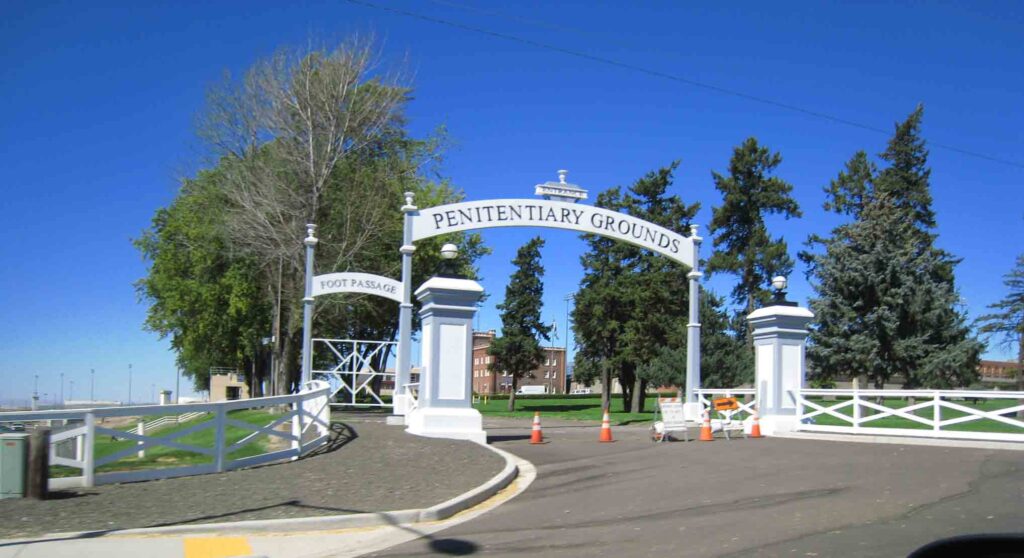
This workforce is highly motivated with unlimited time for work and takes great pride in doing a good job. They also work for “free.” Who is this workforce? They are a select, small group of inmates or ‘offenders’ residing at the Washington State Penitentiary (WSP) in Walla Walla, WA. These inmates were trained this summer to recognize, identify, and enumerate all arthropods on grape leaves, including mites.
Peering in on the microscopic world likely gives our offenders a new perspective on their lives, just as their experience last year did with rearing butterflies. Doing meaningful tasks like these, gives the offenders a much needed sense of achievement and purpose, which in turn helps with prison harmony and sustainability. It is a win-win; win for researchers, inmates and the grape industry!
To date, our surveying has shown generally small populations of spider and rust mites, and a healthy number and diversity of predators. This data has largely originated from the new ‘lab’ at WSP. It is still early in the survey, and the new workforce is still learning, but the signs are good that we are creating some valuable entomological expertise at WSP that will benefit WSU and the Washington grape industry. Detailed results will appear in a future issue of the Viticulture and Enology Extension News.
Spring Sap Flow: The Role of Soil Moisture in Budbreak
By Hemant Gohil, WSU Prosser
Scant rainfall during winter or early spring can result in stunted shoots and poor fruit set in grapevines. Crop losses of up to 50% have been observed in some vineyards after a dry winter. That is what Markus Keller, Professor of Viticulture at Washington State University, observed in 2005, after an unseasonably dry dormant period. However, when he compared vine growth in a vineyard which did not receive pre-bud break irrigation to a vineyard nearby which did, he noticed that the irrigated vineyard had more even bud break and superior shoot growth; clearly the effects of a dry dormant period could be mitigated with irrigation.
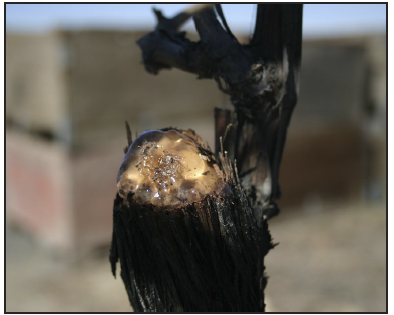
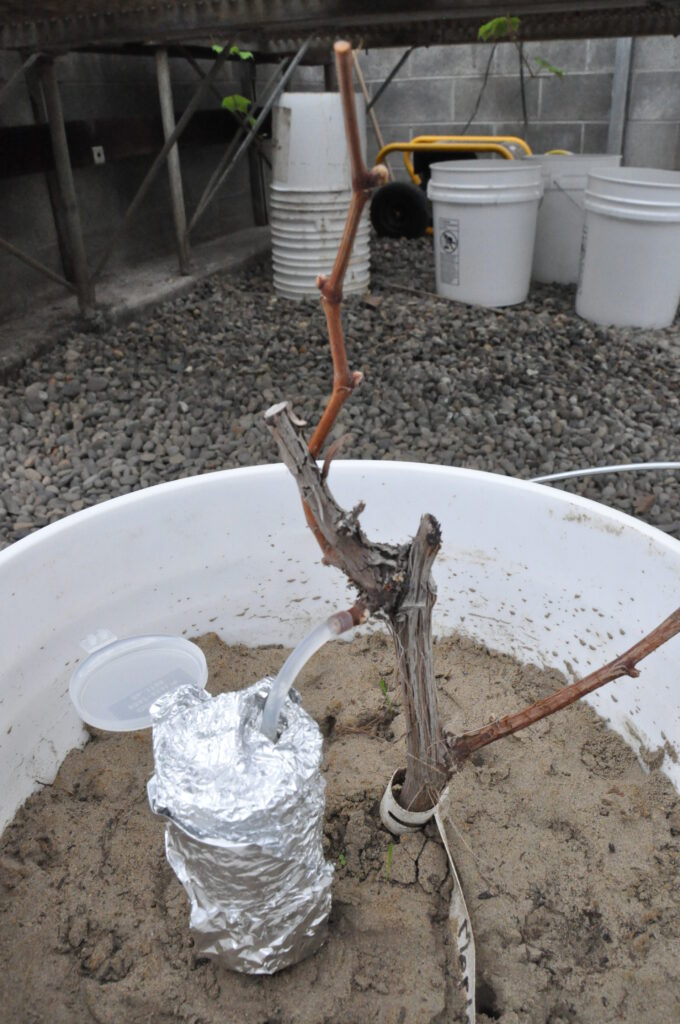
According to Keller, “positive root pressure” in grapevines results from remobilized, stored nutrient reserves that are released into to the water-conducting tissue of the vine (xylem). This raises the osmotic pressure in the xylem, causing the roots to draw more water from the soil, thus pushing the subsequent water and nutrient reserve solution (sap) to the canes. That pressure needs to be released somewhere, and is typically in the form of sap bleeding from pruning wounds (Figure 1). If the soil is too dry, root pressure may not develop and as a result much needed water is not available to growing tissues.
Are there alternative, natural routes that this pressure can be released, such as through the breaking of buds and the growth of shoots? In other words, is sap flow related to bud break timing and speed?
Starting in 2011, Keller, along with graduate student Colin Lee, initiated studies using potted Vitis vinifera ‘‘Merlot’ vines to see if there was a relationship between soil moisture content and subsequent plant development. This study continued in an expanded form in 2012, conducted by Giulio Carmassi, a visiting student from Italy, incorporating different soil types that were representative of eastern Washington. These included a sandy loam from Prosser, WA and loamy sand from Paterson, WA.
Going into 2013, the trial was once again expanded, including a gradient of different soil moisture content in the two soil types. The gradients included field capacity (FC) to permanent wilting point (PWP). At FC, the soil has the maximum amount of water it can hold; any additional water is usually lost to deep percolation or run off. If a soil is near the PWP, plants have limited ability to extract water from the soil, and can potentially suffer irreversible damage to the plant (i.e., die). In loamy sand, FC is 15% water content, and PWP is 7% water content. In sandy loam, FC is 23% water content, and PWP is 11% water content.
In this experiment, the soil moisture gradients tested were at 1% intervals between FC and PWP. Those levels of soil moisture were maintained through the trial. The plants were then tested for their ability to bleed, and for the quantity of sap they could produce (Figure 2). Bleeding sap was monitored post bud break to determine if vigor (i.e., the rate of shoot growth, total leaves produced, and fruit set) was correlated with the rate of sap flow.
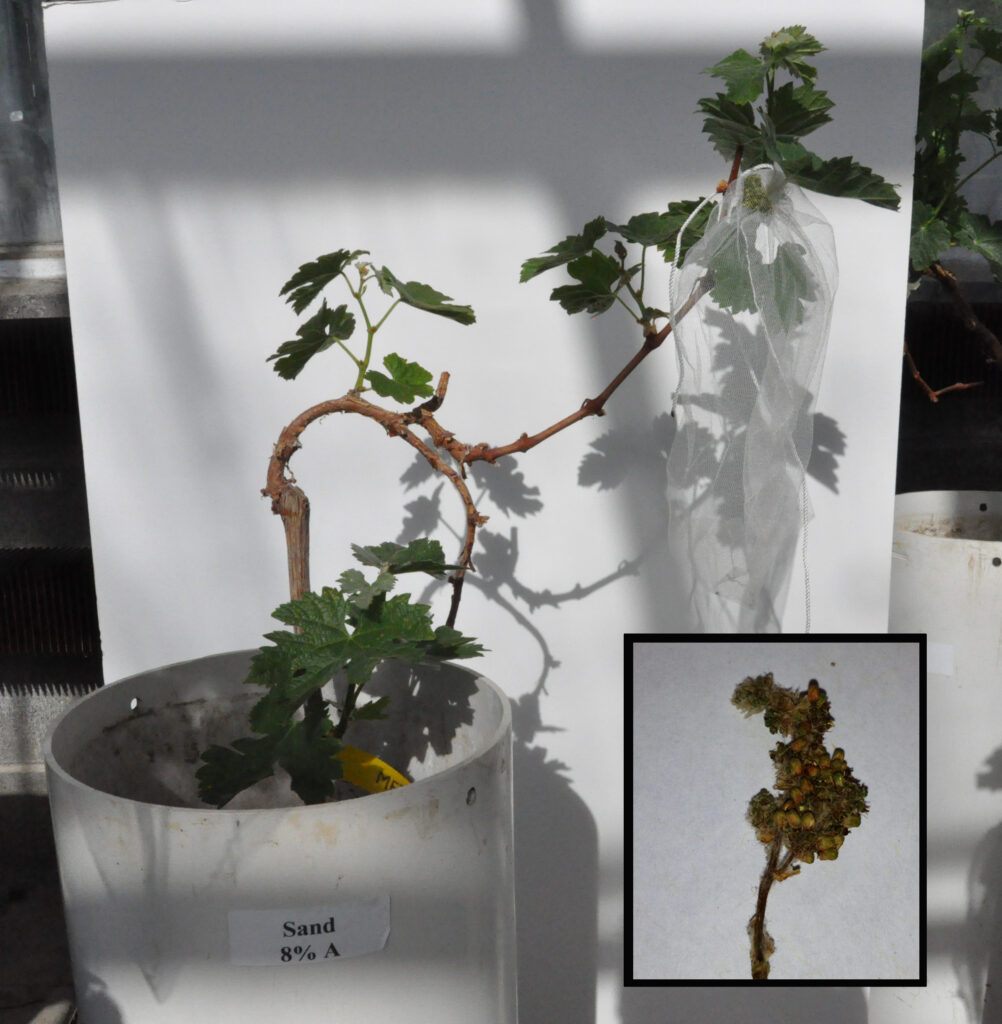
Soil Moisture Influences Early Season Growth. Sap flow started almost immediately (within 1-3 days) in vines that were irrigated to FC. This was followed by rapid and uniform bud break, and shoot growth. In vines maintained near PWP after transfer from cold storage, delayed bud break occurred, and sap flow was not observed.
Interestingly, preliminary tests showed that if vines that were initially maintained at PWP were watered back to FC (before the buds died), they would resume normal bud break and shoot development.
Shoot growth and sap bleeding rate were strongly correlated with soil moisture in both soil types. Shoot vigor (elongation and leaf expansion) was the greatest when soil moisture levels were at FC to 2% less than FC (i.e., 13-15% for loamy sand, and 21-23% for sandy loam). When soil moisture declined, vine vigor declined and fruit set also declined.
Overall, vines in soil that was near PWP (i.e., 7% water content in loamy sand, and 11% water content in sandy loam) had very poor growth, or neared death; however, vines at 1% above the PWP (i.e., 8% water content in loamy sand and 12% in sandy loam) survived although inflorescence abortion was seen (Figure 3, inset).
This study will be continued in 2014, to see when drought stressed vines should be watered to prevent long-term detrimental effects. In other words, at what point can vines at PWP be watered to FC and still produce a viable crop and functional canopy.
Irrigate Early! Based on these results, we advise growers to measure soil moisture before bud break and to irrigate if the moisture level is at 4% below FC or lower. Use the Irrigation Scheduler Mobile (information highlighted in another article in this issue of VEEN), to help determine what FC should be for your site. Alternatively, irrigation could be initiated if sap bleeding does not start despite warming soil temperatures (i.e., soil temperatures above 45°F) or if bud break seems erratic despite favorable air temperatures (i.e., air temperatures above 50°F).
While spring conditions are typically wet in the PNW, do not forget the importance of recouping from a dry winter with added irrigation. This will optimize early canopy development and minimize crop loss. To overcome the potential problem of winter drought-stress – know your soil moisture and, if necessary, irrigate when the water gets turned on!
Irrigation Scheduler Mobile: New and Improved!
By Troy Peters, WSU Prosser
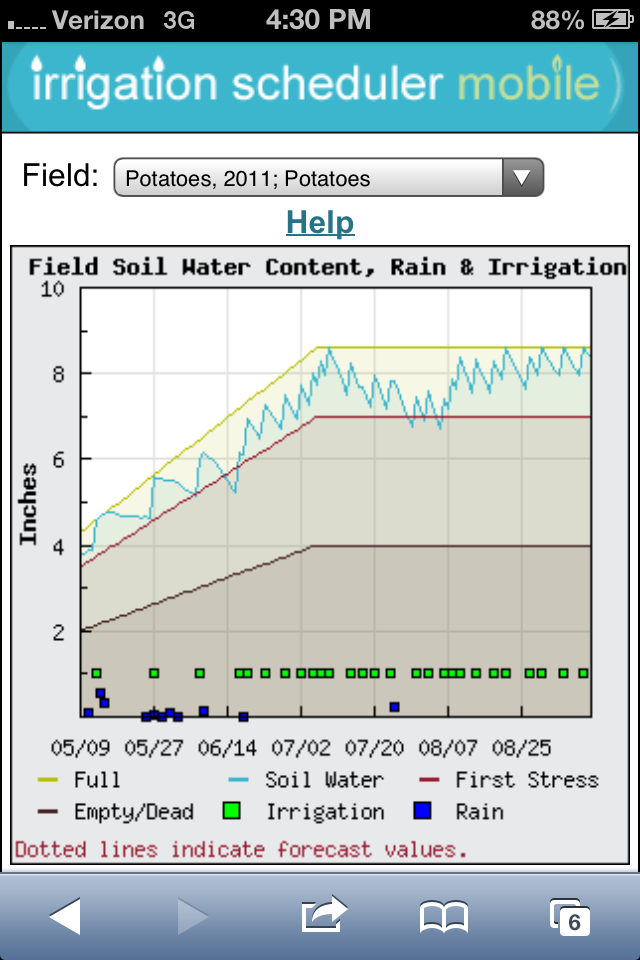
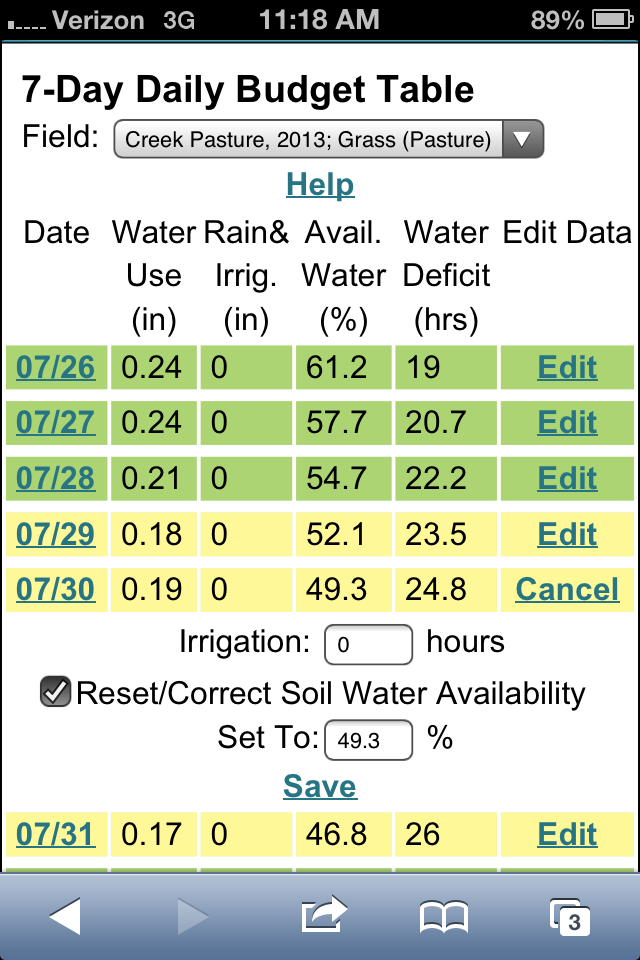
Irrigation Scheduler Mobile is a simple, easy-to-use web application for irrigation scheduling. It is formatted for use on any smart phone as well as on any web browser. It automatically pulls crop water use estimates from weather networks, and does a simple soil water balance to help estimate current soil water content (Figures 1, 2). This can be used to help you make decisions on when to irrigate, and how much to apply.
Thus far, the Irrigation Scheduler Mobile has been well-used, with over 800 registered growers, who have set up over 1500 fields.
We have made improvements to Irrigation Scheduler Mobile to make it even more intuitive and user-friendly. We have also added many features that you were asking for, including:
- A full page version for use on the main AgWeatherNet (weather.wsu.edu) site.
- Functionality with weather data from AgriMet; making it useful for all growers in the west instead of just Washigton growers.
- A one-week, crop-water-use forecast for irrigation decision planning.
- Modifications for water use in hay-cropping systems. It can account for hay cutting by having cutting dates as an input. Outputs include both hours of irrigation run time and inches of applied irrigation water. Simple calculators are included to help you calculate your irrigation application rate.
- Correction factor for vineyards and orchards that do not irrigate inter-row spaces.
- Push updates or notifications can be sent as either an email or as a text (SMS) message to your phone. These can be delivered daily, or only when the soil has dried below a level that you specify.
- Easy transfer of field settings from one location set-up to another. When adding a new field you can copy settings from another field; useful if setting up multiple similar fields, or setting up the same field in a new year.
- Use reporting for the number of days you use the tool to view or edit the data for your fields.
- In-application help pages for every screen as well as a full user’s manual.
Irrigation Scheduler Mobile is a simple way to significantly improve your irrigation water management. Improved irrigation scheduling can help you increase crop yields and quality while decreasing water use, pumping power use, labor costs, and fertilizer use. Irrigation scheduling can simultaneously decrease potential damage from run-off or leaching of water containing pesticides, nutrients, or sediment. In short, everybody wins! If you use a smart phone, you already have what is necessary to get started; if not, power on your computer and give it a try!
Irrigation Scheduler Mobile was developed by Troy Peters, the WSU Extension Irrigation Specialist in collaboration with Sean Hill, AgWeatherNet Programmer, and Gerrit Hoogenboom, AgWeatherNet Director.
Wine Microbiology Laboratory Update
By Charlie Edwards, WSU Pullman
Research Update
Research continues to study ways to limit growth of the spoilage yeast, Brettanomyces, in wine. Brettanomyces contamination, referred to as ‘Brett,’ can result in wines with negative off-flavors, and is often confused with cork taint.
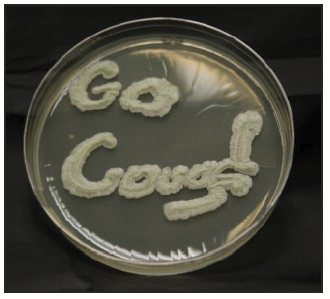
Financially supported by the Washington State Grape and Wine Research Program, the Edwards laboratory at Washington State University in Pullman has conducted experiments to determine the impacts of various fermentation practices and products on the development of this yeast. Items being evaluated are: the use of sulfur dioxide (SO2) at various temperatures, the addition of Velcorin®, a yeast inhibitor, the addition of chitosan which is also used as a yeast inhibitor (Figure 1), in addition to other antimicrobial additives as means to help control the Brettanomyces growth.
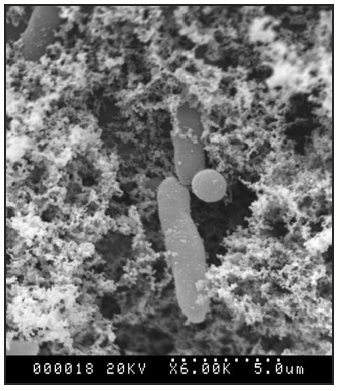
Thus far, results suggest that storage at temperatures less than 59°F (15°C) in combination with molecular sulfur dioxide concentrations of greater than 0.4 mg/L, help to limit growth of Brettanomyces under typical aging conditions for red wine. The yeast also appears to be removed from wines using absolute (membrane) with pore sizes of ≤ 0.8 µm. Dimethyldicarbonate (Velcorin®) reduced the growth of the spoilage yeast when in laboratory settings, but the ability of the product to kill Brettanomyces depended on the strain of the yeast and the temperature at which it was grown.
Using both laboratory-scale experiments and pilot plant-scale oak barrels, chitosan was successful in reducing populations of Brettanomyces approximately 10,000X, making it an attractive option for use by the wine industry.
Additional current research in the Edwards lab includes: (a) impact of native non-Saccharomcyes yeasts on fermentations, (b) influence of ethanol and temperature of growth of Brettanomyces in wines, and (c) alternative indicators of Brettanomyces infections. Look for updates in future issues of the Viticulure and Enology Extension News.
Extension Update
While the popularity of the 1990 Extension manual called Laboratory Manual for Wineries (MISC 0146) has not waned, it has become out-of-date. Current work is underway to revise this manual with updated protocols.
The addition of coauthor Dr. Bruce Watson of South Seattle Community College, who has more than 20 years experience developing and implementing analytical protocols for wine laboratories has taken this manual to the next level. More emphasis is placed on the interpretation of analytical methods.
This new WSU Extension manual is titled Basic Microbiological and Chemical Analyses for Wine (EM047) and is available for download.