VEEN is curated by WSU Viticulture Extension. For questions on articles, or to request to submit an article in future issues, reach out to Michelle Moyer.
This issue of VEEN was originally published as a .PDF in September 2019, and posted online. Some content here will differ from that original issue. The issue is archived, but accessible on the VEEN Archive webpage.
A Note from the Editor
The 2019 vintage has been a wild ride! Transitioning from a colder winter with heavy snowfall (that seemed to stick around forever), to a milder summer with more-frequent-than-normal thunderstorms and humidity, one would expect it to have been a more challenging vintage than it turned out to be. Those milder temperatures? They assisted vines in recovery from cold damage. They were also perfect for fruit development and ripening. That humidity and rainfall? They also assisted in reducing vine stress — albeit at the cost of higher powdery mildew, Botrytis bunch rot, and sour rot pressure. While disease pressure was high, many started their management season strong, coming off of two years where fungicide resistance management was a challenge. The year brought about some challenges, but those appeared to have been met and overcome, and harvest is coming into full swing.
To round out the year, please join us at the Centennial Celebration for WSU Prosser IAREC. We will be celebrating 100 years of service to Washington State on Saturday October 5th. Come out and enjoy this family-friendly celebration with us …. and the opportunity to dunk your WSU Viticulturists (Gwen Hoheisel, Markus Keller, and myself) in a tank of freezing water, for charity, of course!
Michelle M. Moyer
Viticulture Extension Specialist
Professor of Viticulture
WSU Prosser IAREC
Table of Contents
Connect With Us
V&E Certificate Program
Phylloxera Awareness
By Gwen Hoheisel, WSU Extension; Michelle Moyer and Doug Walsh, WSU Prosser
Phylloxera has been detected in Washington vineyards since 1910, primarily in Concord juice grapes (Vitis labrusca). There have been incremental Washington surveys conducted by WSDA and USDA-ARS through the decades, and it is an established pest in Oregon. Recent detection of phylloxera in the Walla Walla AVA warrant a renewed examination of biology and best scouting practices for this insect.
Biology
insect that feeds on the roots (and sometimes leaves) of grapes. They overwinter as nymphs, and in the spring grow to adults within 2 weeks. At which point, they reproduce asexually by laying eggs that hatch in just 10 days. This cycle continues through the season with many stages being possible at any one time. However, their life cycle and ability to reproduce is highly dependent on soil temperatures. Feeding does not occur until soil temperatures are above 64oF and optimum development is between 70 to 86°F [1]. If soil temperatures are too low (less than 42°F) or too high (greater than <91°F) eggs will not hatch [1]. Interesting the optimal temperatures for root growth in a plant (68 to 86°F) coincides with that of phylloxera development. Phylloxera also develops best in soils with higher clay content; soils with more sand can hinder their establishment and growth (i.e., survive but maybe not thrive). Indeed small areas within Australia, Greece, and France that remain phylloxera free can attribute it primarily to the soils having the high sand and low clay content.
While phylloxera is notorious for feeding on roots of Vitis vinifera wine grapes, there is another form that feeds on leaves. Gallicoles are the wingless, gall-forming stage, but they are rare in the Western US. In general, galls are not common on V. vinifera. Radicoles, the wingless root-feeding form of phylloxera, is primarily on V. vinifera. Radicoles can emerge instead as a winged form, called an alate, that disperses to a new site. Alate forms are common in other soil insects like ants and termites that use this mechanism for dispersal, possibly due to high densities or limited resources. Alates will lay eggs that hatch with a wingless sexual form of the insect that mate and start a new colony. Despite this natural dispersal and sexual forms, phylloxera reproduce in a non-sexual form more abundantly. This means that any one colony of phylloxera is clonal. This is important because hundreds of biotypes (specific genetic strain) have been identified and we can use that to our advantage in understanding differences in plant-insect interactions.
Scouting
As with any new immerging issue it is critical to scout for the pest before any action and phylloxera are easiest to detect in the fall.
Identify the Vineyard / Area to Sample
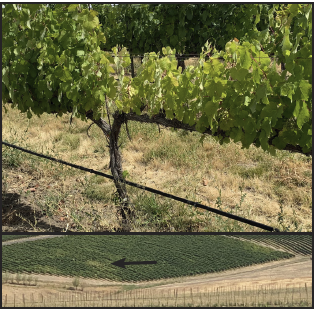
Phylloxera feed on either on growing rootlets, which then swell and turn yellowish, or on mature hardened roots. This feeding induces symptoms in the vine canopy that are similar to water and nutrient stress, due to the lack of water uptake through the damaged roots (Fig. 1, top). Symptoms of infestations often appear in an “oval-shaped” symptom pattern in the vineyard (Fig. 1, bottom), as it more readily spreads down the row rather than between rows. Phylloxera crawlers will move to adjacent, symptom-free plants when their host vine becomes unsuitable.
- The best place to start is with symptomatic vines. But, if there are no symptomatic vines and you are scouting for early detection, target areas of the site with higher clay content or at the corners of the blocks where machines enter the site.
- Sample by digging up roots located directly under drip emitters. Sampling from the top foot of soil is sufficient.
- Sample from both symptomatic (if present) and asymptomatic vines. For initial scouting, sample from at least 10 vines per 10 acre block, focusing on suspect areas.
Look for Probable Phylloxera Damage to the Roots
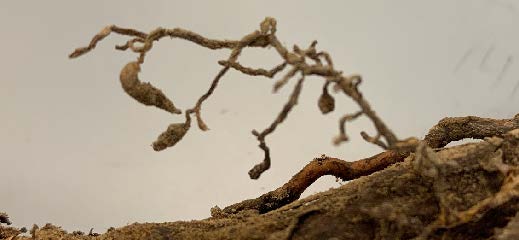
When phylloxera feeds on roots, the plant reacts by forming small galls. Severe feeding will ultimately result in the death of the impacted roots. You will likely not find many phylloxera on severely damaged roots as there is insufficient food for the insect, and they would have moved on.
- Look at your root samples. If you cannot find any fine roots with branching, and only large roots remain, you will likely not find any phylloxera.
- In samples with fine roots, look for small galls on the fine root tips – in many cases, they are similar in size and shape to mouse droppings (Fig. 2).
Look for the Insect
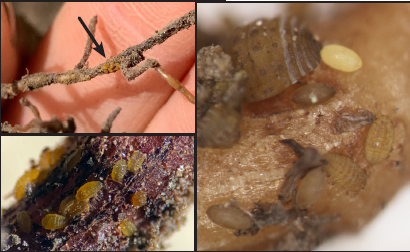
The phylloxera insect ranges in color as it goes through different life stages, from bright yellow to pale yellow to a light brown as an adult. The adult female is about 1 mm in size, and can be seen with the naked eye, but is easier to see with a 10-30X hand lens.
- Scan the roots, paying attention to areas with a rough outer surface (places to hide).
- Under heavy infestations, you can see areas of orange-to-yellow, where the insect is aggregating, however, single louse can only be seen with a hand lens.
Positive Detection – What Happens Next?
Identification of phylloxera in a ‘trouble’ area isn’t ideal, but it will lead to better management strategies, as we cannot manage what we do not know.
If phylloxera is detected this fall, focus on minimizing spread. Crawlers moving to the soil surface are easily spread in dirt on bins, shoes, and tires. Washington Winegrowers (WWG) and WSU have developed a short “best management practices” for harvest and a more detailed plan was developed by the Australian National Vine Health Steering Committee. They are available at the WSU V&E Phylloxera webpage.
We do not recommend any chemical intervention for 2019. Most soil applied products have very long pre-harvest intervals. Foliar applied products are best used when there is active canopy growth; they do not work when the plants are shutting down [2,3]. WSU will be updating the 2020 Grape Pest Management Guide with phylloxera control options and timing.
Using rootstocks is the only long-term solution for phylloxera control. Fortunately, WSU and OSU have done some rootstock research, and more information on rootstocks will be coming this winter. We only recommend replanting, however, after a vineyard is no longer economically viable. Do not rogue individual plants, as that may increase spread within the block.
This winter, focus on learning more about this insect and developing an action plan for the future. Educational events will be conducted at the annual meetings of Washington State Grape Society and WWG. There is also an excellent factsheet on phylloxera from Oregon State University.
References
- J.R. Fisher, & M.A. Albrecht, 2003. Acta Hort, 617.6
- R. A. Van Steenwyk, L. G. Varela, M. H. Ehlhardt, 2007-2008, Arthropod Management Tests, 34:1.
- R. A. Van Steenwyk, A. B. Kiss, R. H. Smith, L. G. Varela, 2009. Arthropod Management Tests, 35:1.
WSDA Grape Phylloxera Sampling 2019 Volunteer Information
By Katie Buckley, Washington State Department of Agriculture
The Washington State Department of Agriculture and Washington State University are working together to gather more information about some recent detection of phylloxera, which is part of the Washington State Grape Pest Quarantine.
To help with the data collection, WSDA and WSU are seeking vineyard operators willing to allow sampling from their vines. Volunteering helps determine where grape phylloxera is located in Washington and whether the pest is present in your vineyard.
This sampling effort will help WSU researchers and extension agents develop best management practices and will limit the inadvertent spread of the pest to new areas.
What volunteers can expect:
- A grape survey trapper will arrive at your vineyard for a root sample, which involves digging a hole one to two feet deep for the sample. No serious harm will come to the vine and the hole will be filled.
- This root sample is sent to the WSDA laboratory in Olympia to determine if it is positive or negative for phylloxera.
- You will be notified of the test results.
Volunteers should email WSDA entomologist Katie Buckley at kbuckley@agr.wa.gov with their name, phone number, and the address of their vineyard.
Volunteers can advise WSDA if they would like the trapper to visit at a set time or provide advance notice. If you have a specific area you would like sampled, for example, an area where you have noticed lowered vine vigor, please include a map, GPS coordinates or detailed instructions to find the location.
If phylloxera is in your vineyard, you can move fruit, but you cannot move any parts of the grapevines out of the vineyard that could be used for propagation, such as live plants, hardwood cuttings, softwood cuttings, or any other plant parts capable of propagation.
WSDA is working with WSU to develop best management practices for managing phylloxera. One recommendation is to clean equipment before it leaves the vineyard.
Thank you for considering to volunteer. Your participation is crucial to protecting the health of Washington’s wine grape industry.
Want to know more?
To learn more about the Washington State Grape Pest Quarantine, please visit WAC 16-483.
Washington to Prepare for an Unwelcome Traveler: The Spotted Lanternfly
By Sven-Erik Spichiger, Washington State Department of Agriculture
Since fall 2014, the spotted lanternfly (Lycorma delicatula), has made itself at home in the forests, hedgerows, and vineyards of the eastern US. It is an invasive planthopper from Asia, and photos of swarming spotted lanternflies (Fig. 1) attacking Pennsylvania grapes in 2017 were cause of alarm. In 2018, a Pennsylvania grower reported 90% yield loss in a 40 acre vineyard and in 2019, all of the vines at this block were dead.
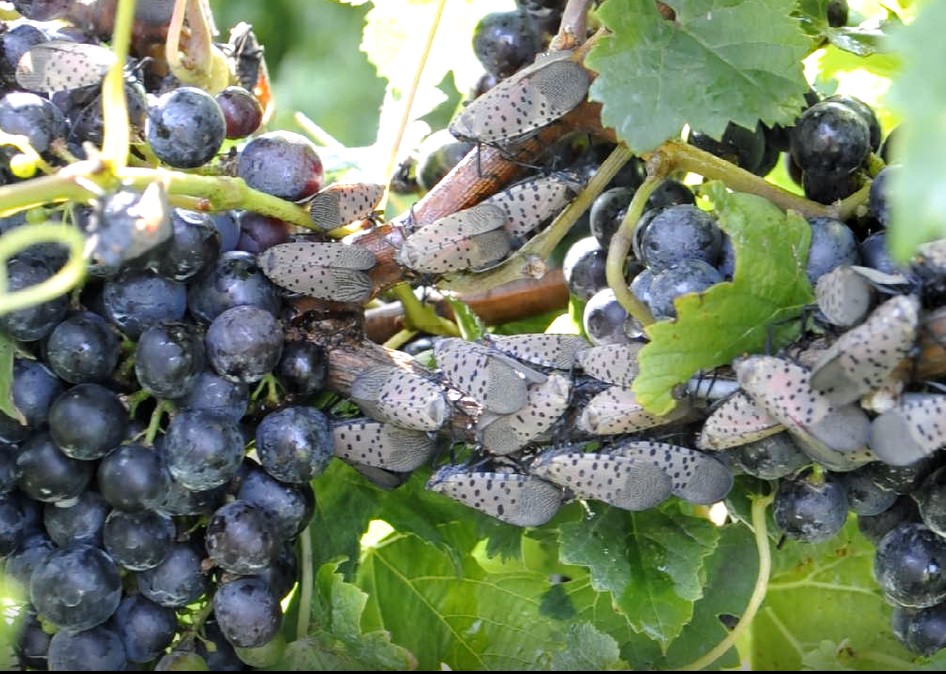
Reported impacts from spotted lanternfly include:
- Plant mortality – e.g. 100% plant loss in an 8-acre Pinot noir planting in PA in 2018.
- Yield reduction – e.g. 45% yield reduction from 2016-2018 in a 10-acre Chardonnay planting in PA.
- Increased pesticide use – A PA grower survey covering 2016-2018 indicated an increase of insecticide applications from an average of 4.2 to 14 annual applications. Treatment costs increased from $54.63 to $147.00 – attributed to management of the spotted lanternfly.
The problem isn’t going away in Pennsylvania, with more vineyard reporting spotted lanternfly in 2019. Penn State Extension produced a guide titled “Spotted Lanternfly Management in Vineyards”. It is a recommended reading for any grape grower.
Should Washington growers be concerned? Yes. Spotted lanternfly is a world traveler and is able to quickly establish and reproduce in new, remote areas. Though it makes use of over 70 different host plants, it demonstrates a preference for the invasive tree of heaven (Ailanthus altissima). This invasive plant grows in disturbed areas and is readily found adjacent to rail lines and edges of parking areas. (Fig. 2). Spotted lanternfly seeks out these trees out just prior to mating and laying egg masses. After mating, egg masses can be laid on almost any outdoor surface including train cars and semi-trucks.
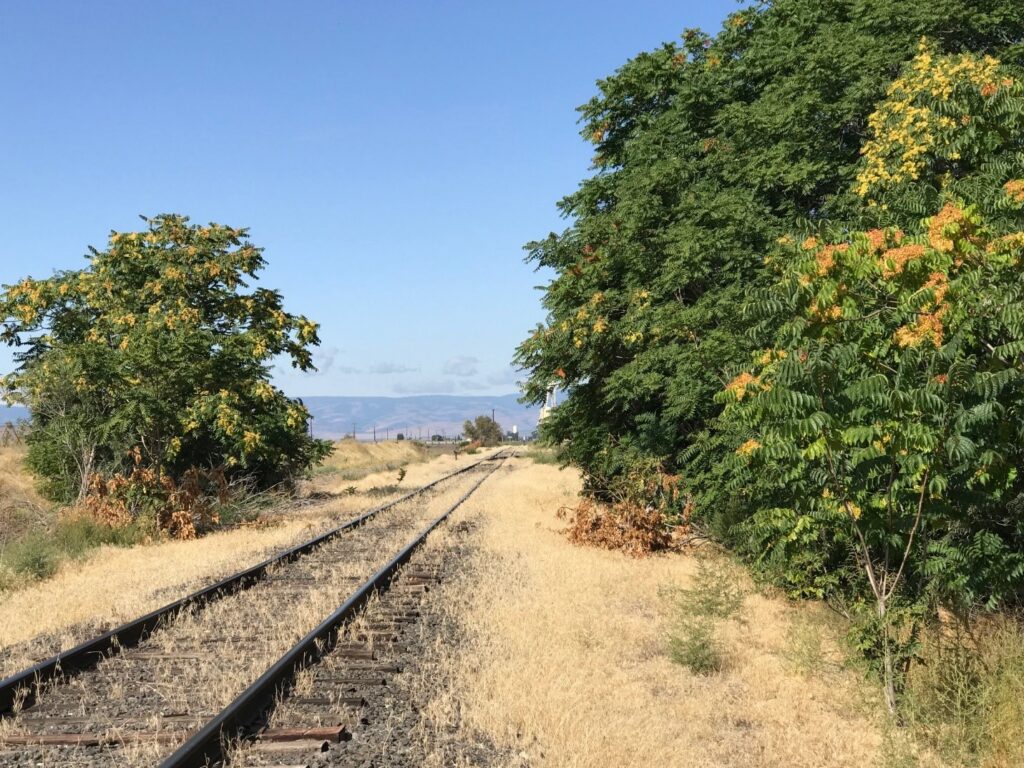
Given the abundance of tree of heaven and its proximity to long-distance conveyances like trains and trucks, the probability of introduction to Washington State is high. Other high-risk pathways – like moving pods and recreational vehicles – have been implicated in moving European gypsy moth from the East coast to Washington for decades, and this could be an additional mode of transport as spotted lanternfly egg masses can go unnoticed, and slip into the state.
Making Washington an unwelcome place for spotted lanternfly before it arrives can make our state less hospitable to this pest. The Washington State Department of Agriculture (WSDA) is acting now before spotted lanternfly pays a visit. WSDA’s first step is to map where the pest’s preferred host, tree of heaven, occurs in the state. When populations of this invasive tree are found adjacent to high-risk pathways, like rail, trucking, or recreational areas, WSDA will work with county weed boards to help property owners develop vegetation management plans to remove it.
WSDA also encourages all citizens to remove tree of heaven on their property. However, simply cutting down tree of heaven will NOT remove the tree. For information on how to control tree of heaven, property owners are encouraged to work with their county weed board. By eliminating the spotted lanternfly’s invasive primary host where the pest is most likely to arrive and thrive, residents can protect their environment as well as valuable agricultural industries like grape, hops, and apples. Residents are also encouraged to report sightings of this or any other invasive pest to WSDA, the Washington Invasive Species Council, or your local extension office.
Managing Water for Different Wine Grape Varieties
By Joelle Martinez, post-doctoral research associate, and Markus Keller, WSU Prosser
Research in wine grape irrigation has been trying to classify varieties according to their water stress responses. This need is justified because wine grape varieties planted in the same vineyard often do not show a uniform response to the general regulated deficit irrigation management strategy that may have been applied across the entire farm.
A classic tale considers wine grape varieties in two groups, using leaf water potential as robust plant-based indicator of water stress: The optimists and the pessimists. Pessimist varieties show a high leaf water potential that remains constant with soil moisture depletion. On the other hand, optimist varieties show a leaf water potential that drops as soil moisture depletion increases. Knowing which varieties fall into these groups is important because it could allow the grower to address each group with a different irrigation strategy to optimize vine health and fruit quality.
A four-year experiment conducted at WSU Prosser IAREC aimed to determine if it is possible to classify wine grape varieties into groups that have different responses to water stress. Eighteen own-rooted varieties, grown side by side, were used. From 2015 to 2018, the soil was irrigated to saturation pre-veraison and post-veraison and was allowed to dry down between irrigation sets by completely withholding water until signs of water stress were visible on the vines. During each dry down cycle, soil moisture and midday leaf water potential were measured repeated for each variety. Variability in the field was controlled by replicating each variety four times, and a total of 8 vines were monitored for each variety.
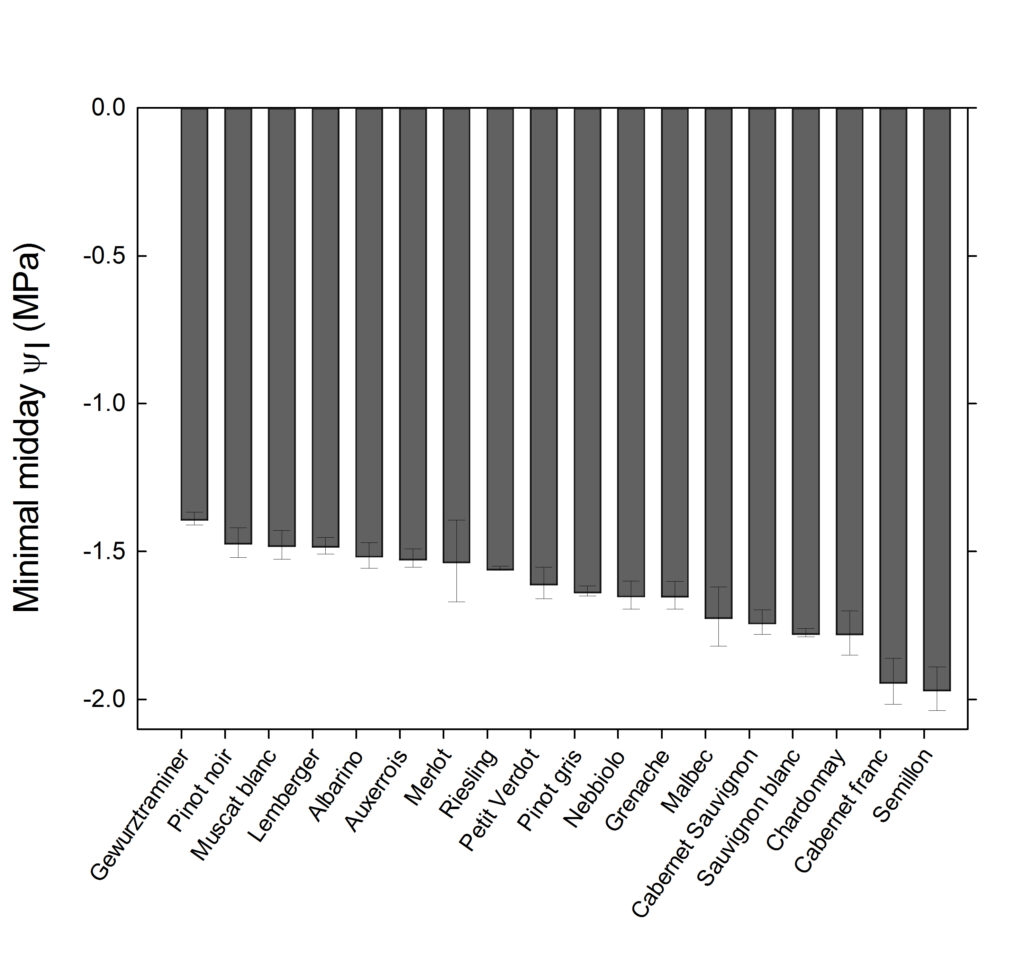
When the lowest leaf water potential recorded across the four years was analyzed, a more complicated picture of varietal differences than the one portrayed in the classic tale emerged. As seen in Figure 1, there was a continuum among varieties of the minimal leaf water potential they operated at. Certain varieties such as Gewürztraminer operated down to minimum of -1.3 MPa while others like Semillon operated down to a much lower minimum of -1.9 MPa. However, there was no distinct separation found among the 18 varieties that allowed us to group them into different categories. Instead, this result suggests that each variety should be considered individually in terms of its specific operating leaf water potential during soil drying.
When plotting the trajectory that the water potential takes as soil moisture decreases, some varieties showed indeed a drop in a straight line as was expected from the classic tale (for the optimists). However, different varieties had different rates or slopes of that drop: A variety like Semillon showed a steep drop while a variety like Riesling showed a much milder drop (Fig. 2A). Other varieties initially showed no drop as was expected from the classic tale. However, this plateau was present only until the soil moisture reached a threshold of about 14% (v/v) in this Warden silt loam; below 14% the leaf water potential started dropping in a straight line. (Fig. 2B).
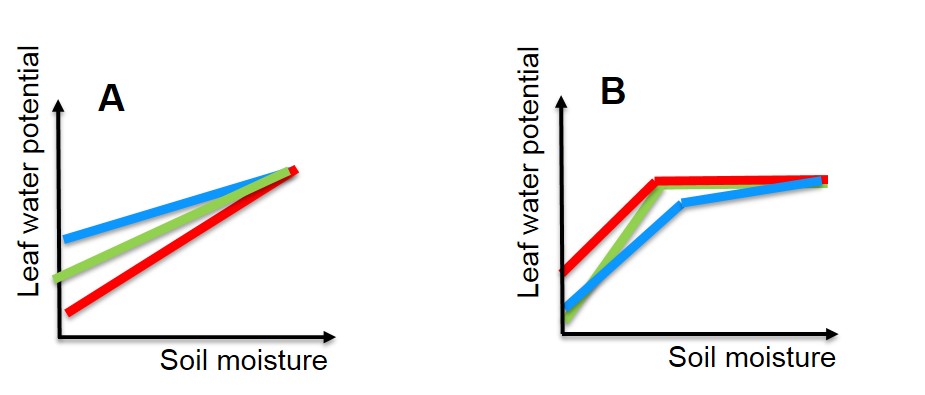
Rather than grouping the varieties according to how they drop their leaf water potential during a soil dry down (as suggested by the classic tale: no drop versus linear drop), each variety should be considered as a separate individual having a specific progression of the water potential during soil moisture depletion.
Combined, these results have practical implications for managing irrigation in vineyards planted with different varieties. Growers usually have a certain level of water stress in mind to optimize production quality. Because the combination of the change in leaf water potential and soil moisture is specific for each variety, deciding when and how much to water based on soil moisture alone, will yield different levels of water stress in different varieties. If only leaf water potential or soil moisture status were used to determine irrigation, rather than their combination, it could result in under or over-estimating the stress level in some of the varieties. This might be the reason why some varieties are difficult to manage.
This conundrum results in less than optimal decisions on how much water to add back to maintain the desired level of stress for any given variety. In order to manage the differences in a vineyard, our research found that the combination of both soil moisture and leaf water potential should be characterized for each variety under a certain set of growing conditions. Ideally, the two variables should be monitored in parallel to tailor irrigation water scheduling to different varieties, at least until the behavior of each variety is understood for a given vineyard site.
Although the level of sophistication for water stress monitoring varies largely among growers, a two-pronged approach could still be applicable in many cases. Even when vine water status is determined by mere visual observations and soil moisture is determined by using a shovel, following how the two variables progress together as water is withheld for each variety is the most optimal strategy to manage the different varieties.
This research project was funded by the Washington State Grape and Wine Research Program, and Washington State University.
Sensory Analysis of Wines made with Non-Saccharomyces Yeasts
By Victoria Paup, graduate student, and Carolyn Ross, WSU Pullman
There has been a trend towards decreasing the alcohol content of wines in the last few years. The use of wine yeast to produce wine with reduced alcohol remains one of the simplest strategies for winemakers to implement. Non-Saccharomyces yeasts, which are a part of the natural microflora on grapes, are generally incapable of completing alcoholic fermentation, but, their co- or sequential inoculation with S. cerevisiae is becoming popular.
The use of non-Saccharomyces yeasts at the start of fermentation allows these yeasts to utilize sugar to produce different flavors and aromas compounds, but only limited alcohol. This results in wine with a lower alcohol content and potentially different sensory properties [1]. Some of these non-Saccharomyces yeasts also have the ability to produce pectinase, an enzyme that breaks down pectin found in the grape cell wall, potentially influencing wine mouthfeel [2,3]. Limited research has explored the effects these non-Saccharomyces yeasts on the sensory properties of wine, particularly the mouthfeel. We explored the effects of a non-Saccharomyces yeast cocktail containing Cryptococcus adeliensis, Issatchenkia orientalis, and Pichia kluyveri on the sensory and chemical properties of white and red wine when pectin was present in high or low concentrations.
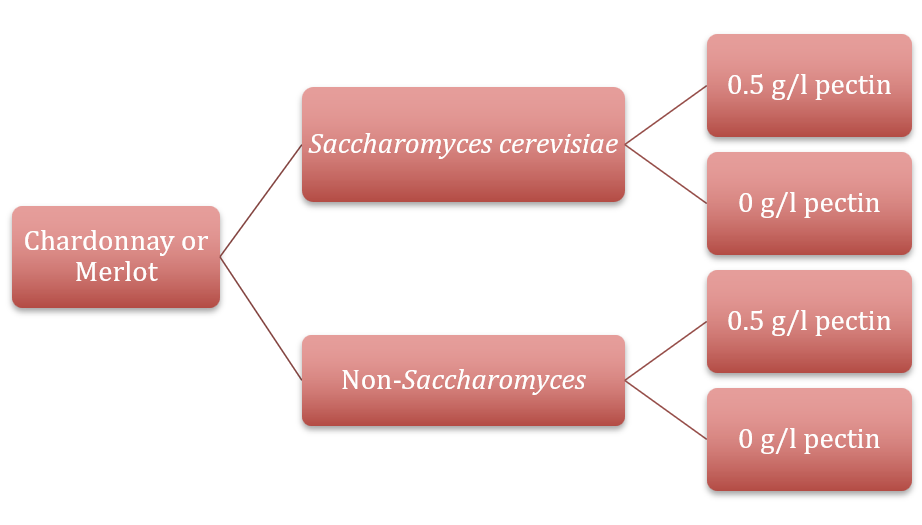
We applied our treatments to Merlot and Chardonnay grapes, Figure 1, resulting in 4 total treatments. The non-Saccharomyces yeasts were inoculated 3 days prior to inoculation with S. cerevisiae. After the wines completed fermentation, they were evaluated by a trained sensory panel and underwent chemical analysis.
Red Wine Results
The chemical analysis of the red wines showed some interesting differences. The most notable was the concentration of D-galacturonic acid, which served as an indication of the amount of pectin present in the wines. The highest concentrations of D-galacturonic acid were seen in wine samples that were produced with the non-Saccharomyces yeast, regardless of pectin addition. Also, wine treatments containing pectin were lower in ethanol than their non-pectin added counterparts. Few differences were found among the other measurements.
Sensory results showed that both of the non-Saccharomyces yeast treatments were similar to each other and were described by berry and dried fruit aromas and flavors, as well as being related to the D-galacturonic acid levels. The S. cerevisiae treatment without pectin was described by the roughness and puckering mouthfeel, and solvent, sulfur and earthy flavors or aromas. The final treatment, S. cerevisiae with pectin, had higher floral aromas, along with the mouthfeel attributes tingle, hot and astringent. These results suggest that the addition of pectin to the treatment fermented with the non-Saccharomyces yeasts had a limited sensory impact, but pectin addition to the treatment fermented only with S. cerevisiae resulted in larger differences.
White Wine Results
For the chemical analysis in white wine, different trends were observed compared to the red wines. Unlike with the red wines, the D-galacturonic acid was highest in the white wine treatments that had added pectin, and not by the yeast treatment. Glycerol concentrations, a fermentation by-product that likely influences mouthfeel, were higher in the non-Saccharomyces yeast treatments than the other treatments, regardless of pectin addition.
The sensory panel indicated wine treatments without pectin were similar and described by attributes such as drying, roughness, and woody aromas. The wine fermented with the non-Saccharomyces yeasts plus added pectin were associated with a tingle mouthfeel, with citrus, butter, and tropical fruit aromas, as well as higher glycerol levels. The wine produced with Saccharomyces with added pectin was described by pear, floral, green apple and honey aroma and flavor. These results suggested that, compared to red wine, the addition of pectin may have a larger overall effect in white wines regardless of the fermentation.
Summary
From this study, which was funded by the Washington Wine Industry Foundation, we found that chemical and sensory changes resulted in both red and white wine when non-Saccharomyces yeasts were utilized during the fermentation process. While this cocktail of non-Saccharomyces yeasts did not alter the alcohol content substantially, it did significantly increase the chemical compounds, such as glycerol in the white wines that likely influence the mouthfeel properties of wine. The addition of pectin to red wine increased the fruity aroma, and decreased the perception of sulfur aroma and viscosity, while in white wines, pectin addition led to an increase in grassy, floral and solvent aromas. These findings signify that the use of non-Saccharomyces yeasts that utilize pectin may be useful in altering sensory properties of wine.
References
- Varela. C., Sengler, F., Solomon, M, & Curtin, C. 2016. V Food Chem. 209: 57-64
- Sieiro, C., Garcia-Fraga, B., Lopez-Seijas, J., da Silva, A.F., & Villa, T.G. 2012. Food Industrial Processes – Methods and Equipment, Valdez (Ed.)
- Domizio, P., Romani, C., Lencioni, L., Comitini, F., Gobbi, M., Mannazzu, I., & Ciani, M. 2011. Outlining a future for non-Sac Int. J. Food Micro. 147: 170-180
Research Program to Expand Its Reach
By Melissa Hansen, Research Program Director, Washington State Wine Commission
Viticulture and enology research is front and center in Washington State.
A 300% increase in the Washington State Wine Commission’s research budget and new strategic research plan will expand the industry’s research reach and support an estimated $5.5 million worth of projects over the next four years.
The Wine Commission launched the new four-year research plan, following approval by the Wine Commission Board of Directors, to serve as a roadmap to carry the industry’s research objectives forward. The plan, which was effective on July 1, builds on the current accomplishments of Washington’s industry-driven and guided research program and strong partnership with Washington State University. For the last three years, the statewide research program, funded by WSU, Auction of Washington Wines, Wine Commission and state liter taxes, has provided more than $1 million annually to WSU for V&E research.
Over 20 WSU research projects are funded for 2019-20. Vineyard topics range from pest management of spider mites, grape mealybug, leafrollers, powdery mildew, grapevine viruses, and nematodes to impact of climate variability on grape phenology, optimizing irrigation by variety, mitigating stress and heat waves to shoot thinning mechanization and crop estimation. Winery topics include wine spoilage and microorganisms, tannin management, impact of fruit maturity on wine quality, smoke exposure, impact of freeze on wine quality, sensory characteristics and influence of pH on wine microbes and wine quality.
But we plan to do even more!
Expanded Reach
As part of the plan, the Wine Commission will initiate a competitive grant program in 2020 to complement the current research program. The Wine Commission’s grant program will extend the industry’s reach by funding:
Short-term research – one-year vineyard and winery demonstration trials and proof of concept research open to students and faculty at Washington community colleges and universities. Industry feedback given to the Wine Commission from its annual research surveys have identified a void of research with rapid, practical application for the vineyard and winery. Although all types of research, from basic to applied, are needed to address industry challenges, demonstration trials have potential to be particularly helpful to small wineries and growers unable to conduct in-house wine or vineyard trials.
Collaborative research with other regions – open to research institutions outside WSU. The goal is to create a funding mechanism to facilitate WSU scientists to work with researchers at other institutions and wine regions.
Strategic research initiative – aims to drive the industry’s research portfolio by targeting a selected research topic, sponsoring a research summit to engage the research and development community and allocating significant funding to encourage innovation, new learning and new technologies.
Accessibility
We will continue coordinate with WSU to use a variety of channels to make research results and outcomes available to all Washington wine grape growers and wineries. Examples of current communication methods are the Wine Commission- and WSU-sponsored research seminars dubbed WAVE (Washington Advancements in Viticulture and Enology); WSU field days and workshops; research articles published in trade magazines; and research featured in the WAVE Report, a quarterly research newsletter distributed by the Wine Commission. For those interested in more in-depth reading, over 50 research reports are archived on the Wine Commission’s Research Library webpage.
New in 2020 will be webinar recordings from WAVE and WAVEx. The webinars will be archived on the Wine Commission’s website.
To learn more about the Wine Commission’s new research grant program, visit the Wine Commission’s Research History and Funding webpage.
If you aren’t receiving the quarterly WAVE Report or monthly Wine Commission newsletter, send an email to get on the list: mhansen@washingtonwine.org .